The Power of Data in the Railway Industry

Many industries are currently working on digitizing all or part of their value chain. The goal is to increase productivity, optimize processes as well as optimize resources.
The railway industry is no exception. Here, digitalization offers many new opportunities while meeting great demands from existing processes, systems, and legal requirements. Many different stakeholders need to be involved and traditions challenged while maintaining the need for control and reporting.
New technologies make it possible to collect and process data in ways that were not previously possible. In recent years new products have entered the market that addresses digitization, data collection, and data processing in the railway industry. Interest in these products is also increasing. This is recognized by Railmonitor, a company that delivers solutions for automatic monitoring of the railway.
Niels Juul, CTO in Railmonitor, says:
“At Railmonitor, we experience a desire from the railway infrastructure owners to have as simple an access to data as possible. In addition, it is desired that the derived decision support can be gathered in a central location. That way, one can avoid a patchwork of systems that need to be managed. Today, several different suppliers of sensors, product systems, and corporate platforms are on the market, working together to standardize such solutions”.
Better services with digital transformation
In other words, the railway industry is amid a digital transformation. With it comes massive amounts of data to be analyzed and processed. But how do you ensure that the industry gets value out of the collected data? This is something Railmonitor has an ongoing focus on:
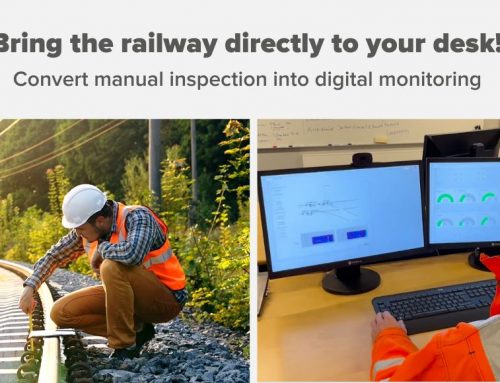
“We are very aware of Railmonitor’s position in the data chain as well as where and how we can bring value. Our focus is to reduce manual measurements and processes by placing sensors in the track and processing a variety of collected data. We use advanced algorithms to derive and generate various decision support tools as well as establish an overview and history in an automatic way” says Niels Juul. He continues;
“For example, it can be mentioned that based on the collected sensor data compared with the behavior we see in the various functions of the switch, we can derive quite interesting functions and contexts”
As a result, Railmonitor can continuously offer new support functions and tools to their customers. This makes customers’ daily work with planning and prioritization of operation and maintenance easier. In addition to reducing ongoing operating and maintenance costs, it can also help increase overall uptime – for the benefit of train passengers!
To be successful in choosing technology, one must consider it as a whole and as something that can easily be included in the operation of the railway. This way, it is avoided that the sensors suddenly become the subject of maintenance.
Valuable co-creation is the path to technological progress
At Railmonitor, they develop their products in close collaboration with customers in what they call “co-creation”.
”We are experiencing a mutual curiosity about the technologies. From our customers, we also receive a very valuable knowledge of not only what opportunities and value it can provide the railway, but also specific and invaluable knowledge about the railway infrastructure” Niels Juul says.
The potential lies within the subsequent data analysis and prediction, for which Railmonitor uses machine learning and artificial intelligence. Based on the knowledge and experience they gather from the behavior and failures of the various turnouts, Railmonitor can continuously and automatically assess the condition of the turnout and see incipient trends and failure scenarios.
According to Niels Juul, it is the combination of data that provides the unique knowledge of the turnout;
”The combination of data from different sensors as well as information from existing systems makes it possible to produce advanced analyzes. It provides a deeper insight and understanding of the maintenance activities performed. Furthermore, it gives a deeper insight into the performed maintenance activities and provides an understanding of whether what has been adjusted or replaced in the switch also adds the functional value. Which in turn means that you get the opportunity to prioritize and optimize your maintenance work”.
Successful digitalization requires an organizational change
The railway industry is amid a digital transformation and many traditions and processes are challenged.
In the last few years, Railmonitor has experienced that infrastructure owners have expressed an increasing interest in the countless opportunities that Industry 4.0 has brought with it. This includes IoT, Big Data, cloud, and edge computing as well as other technologies that can bring value to the industry.
Based on the strategies that the railway infrastructure owners in the European countries work from, Railmonitor is constantly working to be at the forefront of solutions that can support these goals. Based on their experience, the introduction of these new technologies challenges the traditional workflows in the organizations. Additionally, Railmonitor finds that the task of changing and adapting processes and workflows is often more difficult than introducing new technology – because this is about changing human behavior.